
Knee pain can gradually change the way you walk, work, exercise, and even perform simple daily activities. When advanced knee arthritis no longer responds adequately to medicines, physiotherapy, injections, weight management, or other non-surgical treatments, knee replacement may become an option.
Today, patients have more choices than simply “knee replacement.” One important decision is whether to undergo a conventional knee replacement or a robotic total knee replacement in Mumbai. Patients may also be candidates for a partial knee replacement when arthritis is limited to one compartment of the knee.
The answer is not the same for everyone. Robotic technology can improve surgical planning and implant positioning, but the surgeon’s experience, the patient’s condition, implant selection, rehabilitation, and overall treatment plan remain critical.
What Is Robotic Total Knee Replacement?
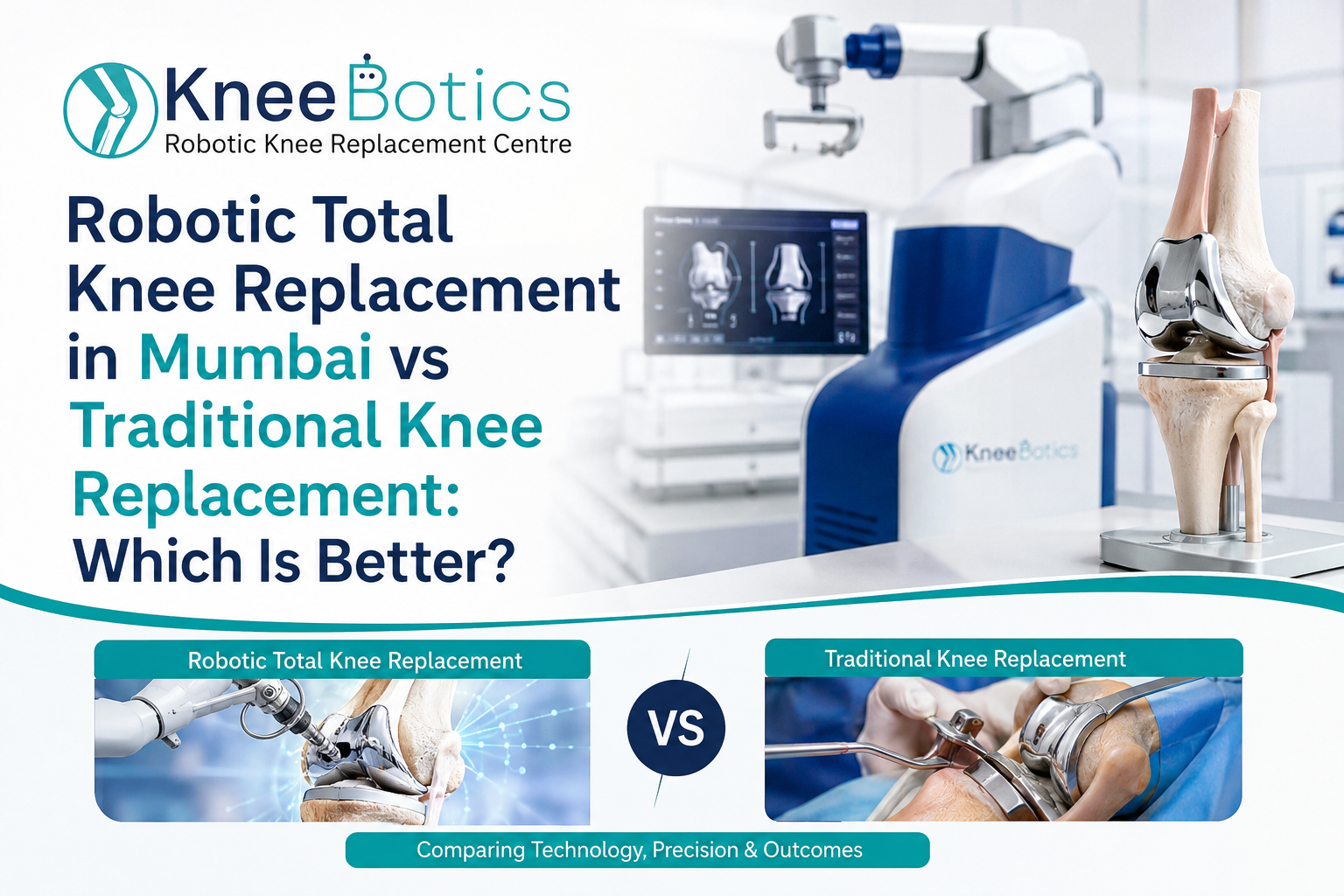
Robotic-assisted total knee replacement combines the expertise of an orthopaedic surgeon with computer-assisted planning and a robotic system.
Before surgery, the surgeon uses detailed imaging and digital planning to understand the patient’s knee anatomy. During the procedure, the robotic platform helps the surgeon execute the planned bone cuts and implant positioning with a high degree of precision.
Importantly, the robot does not independently perform the operation. The surgeon remains responsible for the clinical decisions and controls the procedure.
At Kneebotics, robotic-assisted knee replacement is performed using the VELYS Robotic-Assisted Solution, which the centre describes as a technology designed to support precision and individualized surgical planning.
What Is Traditional Knee Replacement?
Traditional, or conventional, total knee replacement is a well-established procedure. The surgeon uses conventional surgical instruments, pre-operative imaging and intra-operative assessment to remove damaged portions of the knee and position the implant.
It has been performed successfully for decades and remains an effective treatment for people with advanced arthritis.
Therefore, it is important to understand that robotic surgery is not a replacement for good surgical technique. Instead, it is an additional technology that can assist the surgeon with planning, measurements and execution.
Robotic vs Traditional Knee Replacement: Key Differences
| Factor | Robotic-Assisted Knee Replacement | Traditional Knee Replacement |
| Surgical planning | Computer-assisted and highly individualized | Conventional imaging and surgical planning |
| Implant positioning | Robotic technology assists with precise positioning | Surgeon positions implants using conventional instruments |
| Surgeon control | Surgeon remains in control with robotic assistance | Surgeon performs the procedure manually |
| Technology | Advanced robotic platform | Standard orthopaedic instruments |
| Cost | Usually higher because of technology and associated costs | Generally lower |
| Evidence | Strong evidence for improved alignment; clinical advantages are still being studied | Established long-term clinical track record |
| Suitability | Depends on anatomy, diagnosis, technology availability and surgeon assessment | Suitable for many patients requiring knee replacement |
Research supports an important distinction: robotic-assisted knee replacement generally provides more precise implant alignment, but studies have not consistently demonstrated a large difference in patient-reported function or complication rates compared with conventional surgery. NICE’s 2025 assessment similarly found more precise alignment with robotic systems while noting uncertainty about whether this consistently translates into better clinical outcomes.
Advantages of Robotic-Assisted Total Knee Replacement
1. More Precise Surgical Planning
Robotic technology allows the surgeon to create a detailed surgical plan based on the patient’s individual anatomy.
The system can help the surgeon assess alignment and implant positioning during the operation, potentially reducing unwanted variation in bone preparation.
A 2025 systematic review found that robotic-assisted total knee replacement improved surgical precision and accuracy compared with conventional techniques, although the authors also emphasized the need for stronger long-term comparative evidence.
2. Individualized Implant Positioning
Every knee is different. Factors such as bone shape, alignment, ligament balance and deformity can influence the surgical plan.
Robotic assistance can provide additional intra-operative information that helps the surgeon make decisions tailored to the patient’s anatomy.
3. Improved Alignment Accuracy
One of the most consistent findings in comparative research is improved implant alignment with robotic-assisted procedures.
A meta-analysis of randomized controlled trials found better anatomical and mechanical restoration with robotic total knee replacement, although clinical and functional outcomes and complication rates were statistically similar between robotic and conventional groups.
4. Technology-Assisted Execution
The robotic system can provide boundaries and guidance based on the surgical plan. This can help the surgeon execute bone preparation with greater consistency.
However, the technology is an assistive tool, not an autonomous surgeon.
Is Robotic Knee Replacement Better Than Traditional Surgery?
This is where patients should be careful about marketing claims.
Robotic surgery can be better in terms of precision and individualized planning, but it is not automatically better for every patient or guaranteed to produce a superior clinical outcome.
Current evidence suggests:
- Robotic systems can improve implant alignment.
- Patient-reported outcomes may be similar between robotic and conventional surgery.
- Complication rates are generally comparable.
- Robotic surgery can involve higher initial costs.
- Long-term advantages such as fewer revisions remain an area of ongoing research.
NICE’s 2025 guidance concluded that evidence generally showed robot-assisted surgery to be at least comparable with conventional surgery for several key outcomes, while implant alignment was consistently more precise.
This means the right question is not simply, “Is robotic better?”
A better question is:
“Which surgical approach is most appropriate for my knee, my anatomy and my treatment goals?”
What About Robotic Partial Knee Replacement in Mumbai?
Not every patient with knee arthritis needs a total knee replacement.
If arthritis is confined primarily to one compartment of the knee, a partial knee replacement, also known as unicompartmental knee replacement, may be considered.
In a partial replacement, only the damaged portion of the knee is resurfaced while healthier areas are preserved. According to the American Academy of Orthopaedic Surgeons, appropriate candidates may experience benefits such as quicker recovery, less post-operative pain and preservation of healthy bone and ligaments.
Therefore, robotic partial knee replacement in Mumbai can be an option for carefully selected patients with localized arthritis.
However, partial replacement is not suitable for everyone. Factors such as:
- The location and extent of arthritis
- Ligament condition
- Knee stiffness
- Overall alignment
- Other damaged compartments
- Previous knee problems
- Activity expectations
all need to be assessed by an orthopaedic surgeon.
If arthritis affects multiple compartments of the knee, total knee replacement may be more appropriate.
Robotic Total vs Robotic Partial Knee Replacement
These are not simply two versions of the same operation.
Robotic total knee replacement replaces the damaged surfaces of the knee across the appropriate compartments and is commonly considered when arthritis is widespread or advanced.
Robotic partial knee replacement preserves healthy portions of the knee and replaces only the affected compartment. It may provide a more natural-feeling knee for appropriately selected patients, but arthritis can potentially develop in the remaining compartments in the future.
Your surgeon should determine which procedure is appropriate after a physical examination, medical history and appropriate imaging.
Recovery: Robotic vs Traditional Knee Replacement
Patients often assume that robotic surgery automatically means a dramatically faster recovery. The reality is more nuanced.
Recovery depends on several factors, including:
- Age and general fitness
- Muscle strength before surgery
- Severity of arthritis and deformity
- Surgical technique
- Pain management
- Physiotherapy
- Home support
- Adherence to rehabilitation
Kneebotics notes that many patients begin standing or walking with assistance within the first 24–48 hours after robotic knee replacement, although individual recovery varies.
The goal of either approach is to reduce pain, restore mobility and help the patient return to meaningful daily activities.
Cost of Robotic Knee Replacement in Mumbai
Robotic-assisted surgery generally costs more than conventional knee replacement because of the technology, planning and associated system expenses.
However, the total cost should not be the only factor in deciding between the two approaches.
When discussing the financial aspect with your surgeon and hospital, ask about:
- Implant cost
- Hospital charges
- Surgeon and anaesthesia fees
- Robotic technology charges
- Diagnostic tests
- Physiotherapy
- Follow-up appointments
- Insurance coverage
The final estimate can vary substantially depending on the hospital, implant and individual clinical requirements.
Who May Benefit From Robotic Knee Replacement?
A patient may be considered for robotic-assisted knee replacement when they have significant arthritis or joint damage that is causing persistent pain and functional limitations despite appropriate non-surgical treatment.
The decision should be based on clinical assessment rather than the technology alone. NICE recommends considering joint replacement when symptoms substantially affect quality of life and non-surgical management is ineffective or unsuitable.
Choosing the Right Knee Replacement Surgeon in Mumbai
Technology is only one part of successful knee replacement.
When choosing a surgeon, consider:
- Experience with knee replacement surgery
- Experience with robotic-assisted procedures
- Ability to determine whether total or partial replacement is appropriate
- Hospital and rehabilitation facilities
- Implant options
- Pre-operative planning
- Post-operative physiotherapy and follow-up
- Transparent discussion of benefits, limitations and costs
At Kneebotics, Dr. Kunal Patel’s centre focuses on robotic-assisted knee replacement and lists its Mumbai location and appointment information on its website.
So, Which Is Better: Robotic or Traditional Knee Replacement?
There is no universal winner.
Robotic total knee replacement in Mumbai may be particularly attractive to patients and surgeons who value detailed digital planning and highly precise implant positioning. However, conventional knee replacement remains a proven treatment and can deliver excellent results when performed appropriately.
Current evidence shows a clearer advantage for robotic assistance in alignment precision than in guaranteed improvements in pain, function, complications or implant survival.
For some patients, the most important decision may actually be total versus partial replacement, rather than robotic versus conventional surgery.
The best treatment is the one that matches your knee condition, anatomy, expectations and overall health.
Frequently Asked Questions
1. Is robotic total knee replacement better than traditional knee replacement?
Robotic-assisted surgery offers more precise planning and implant alignment, but current evidence does not establish that it is universally superior in every clinical outcome. Both approaches can provide effective pain relief and improved mobility when appropriately performed.
2. Is robotic knee replacement safe?
Robotic-assisted knee replacement is an established surgical approach. However, as with conventional knee replacement, outcomes depend on patient selection, surgical expertise, the hospital team and post-operative care.
3. Is robotic knee replacement more expensive in Mumbai?
Generally, yes. Robotic procedures may have additional technology-related costs. Your hospital and surgeon can provide an individualized estimate after assessment.
4. What is robotic partial knee replacement in Mumbai?
It is a partial or unicompartmental knee replacement performed with robotic assistance. Only the damaged compartment is replaced, making it different from a total knee replacement. It is appropriate only for selected patients whose arthritis is limited to a suitable area of the knee.
5. How do I know whether I need a total or partial knee replacement?
Your orthopaedic surgeon will assess your symptoms, examination findings, ligament condition, knee alignment and imaging. If arthritis is limited to one compartment, partial replacement may be considered; more widespread arthritis may require total replacement.
6. How soon can I walk after robotic knee replacement?
Many patients can begin standing and walking with assistance within the first couple of days, but recovery varies from person to person. Physiotherapy is an important part of rehabilitation.
7. Does robotic surgery mean the robot performs the operation?
No. The robotic system assists the surgeon with planning and execution. The surgeon remains responsible for surgical decisions and controls the procedure.
8. Can robotic surgery guarantee that my knee implant will last longer?
No. More precise alignment does not guarantee longer implant survival for every patient. Long-term comparative evidence continues to evolve, and factors such as implant quality, surgical technique, patient activity and follow-up also matter.
NAP – Kneebotics
Business Name: Kneebotics – Robotic Joint Replacement Center
Address: Plot No. 3, S V Road, Punit Nagar, Borivali West, Mumbai, Maharashtra 400092
Phone: +91 93727 37914
Email: drkunalpatel@gmail.com
The address and appointment details are listed on the official Kneebotics contact page.
Follow Kneebotics on Social Media
- Facebook: https://www.facebook.com/KneeBotics
- Instagram: https://www.instagram.com/kneebotics/
