
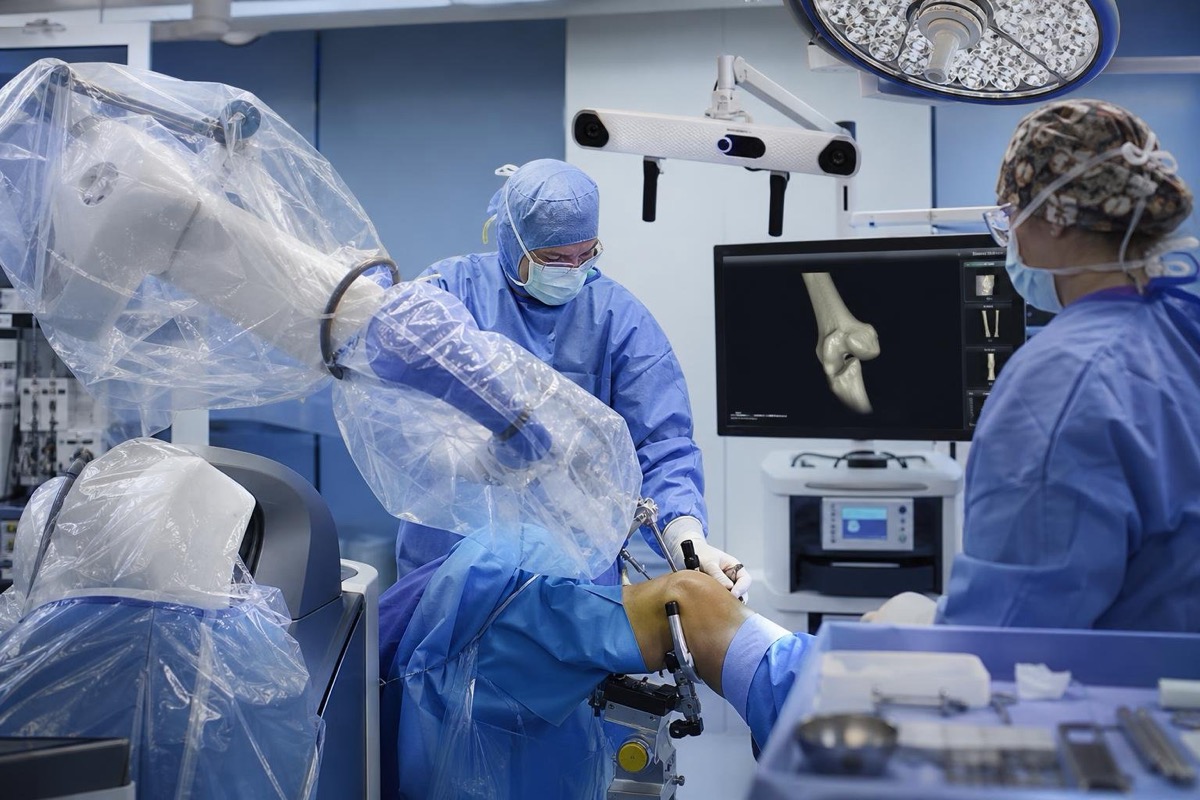
Quick answer: In robotic knee replacement, your surgeon first builds a 3D plan of your knee, from a scan or from mapping done during surgery. In theatre, the robotic system tracks the knee in real time, checks ligament balance, and guides the bone cuts within the planned limits. The surgeon is in control throughout; the robot doesn’t operate on its own. The operation usually takes around one and a half to two hours, and most patients walk with support the same or next day.
“So the robot does the operation?”
No, and that’s the most common misunderstanding we clear up. Robotic knee replacement is surgeon-controlled. The robotic system is a precision tool that helps the surgeon plan and carry out the operation more accurately. Here’s what actually happens, step by step.
Before Surgery: Planning
Tests and assessment
You’ll have standing X-rays, blood tests, an ECG and a check by the anaesthetist and physician. Depending on the robotic system, you may also have a CT scan of the leg, which is used to build a 3D model of your knee.
The 3D plan
Using your scan or intra-operative mapping, the surgeon plans the size and position of each implant component, how much bone to remove, and how the leg should be aligned. This plan is personal to your anatomy.
On the Day: Step by Step
1. Anaesthesia
Most knee replacements are done under spinal anaesthesia, which numbs you from the waist down, often with sedation so you’re relaxed or asleep. A nerve block may be added for pain relief afterwards.
2. Positioning and trackers
Small tracking markers are fixed to the thigh and shin bones. A camera follows these markers so the system knows exactly where your bones are at every moment.
3. Registering your knee
The surgeon touches specific points on the bone with a probe, matching your real knee to the plan. This is how the system “learns” your knee.
4. Checking balance
Before cutting, the surgeon moves your knee through its range and the system measures gaps and ligament tension. The plan can be fine-tuned so the new knee is balanced, neither too tight nor too loose.
5. Guided bone preparation
The surgeon removes the damaged surfaces. The robotic system guides or limits the cutting tool so bone is removed only where planned, helping protect the surrounding ligaments and soft tissue.
6. Trial and final implants
Trial components are fitted and the knee is tested again for movement and stability. Then the final implants are fixed in place.
7. Closing
The wound is closed and dressed. The trackers are removed.
How Long Does It Take?
Typically one and a half to two hours in theatre for one knee, including set-up and registration. You’ll spend some time in recovery afterwards before returning to your room.
After Surgery
- Same or next day: standing and walking with a walker, with the physiotherapist
- Hospital stay: usually a few days
- At home: exercises several times a day, gradually moving to a stick
- Follow-up: wound check, then reviews of your progress
We cover the weeks after surgery in what to expect after robotic knee replacement.
What Does the Robot Add?
The benefits come from precision: a personalised plan, accurate implant positioning and alignment, careful balancing of soft tissues, and controlled bone removal. Read more about robotic knee replacement in Borivali.
Frequently Asked Questions
Is robotic knee surgery done by a robot?
No. The surgeon performs the operation; the robotic system guides and assists with precision.
Will I be awake during robotic knee replacement?
Most patients have spinal anaesthesia with sedation, so you won’t feel anything and are usually drowsy or asleep.
Do I need a CT scan before robotic knee replacement?
Some systems use a CT scan for planning; others map the knee during surgery. Your surgeon will tell you which applies.
Is the incision smaller with robotic surgery?
Incision size is similar to modern conventional surgery. The main benefit is precision rather than a smaller cut.
How soon can I walk?
Most patients walk with support the same day or the day after surgery.
Have questions about the procedure? Book a consultation with Dr Kunal Patel at Punit Hospital, Borivali West.
