
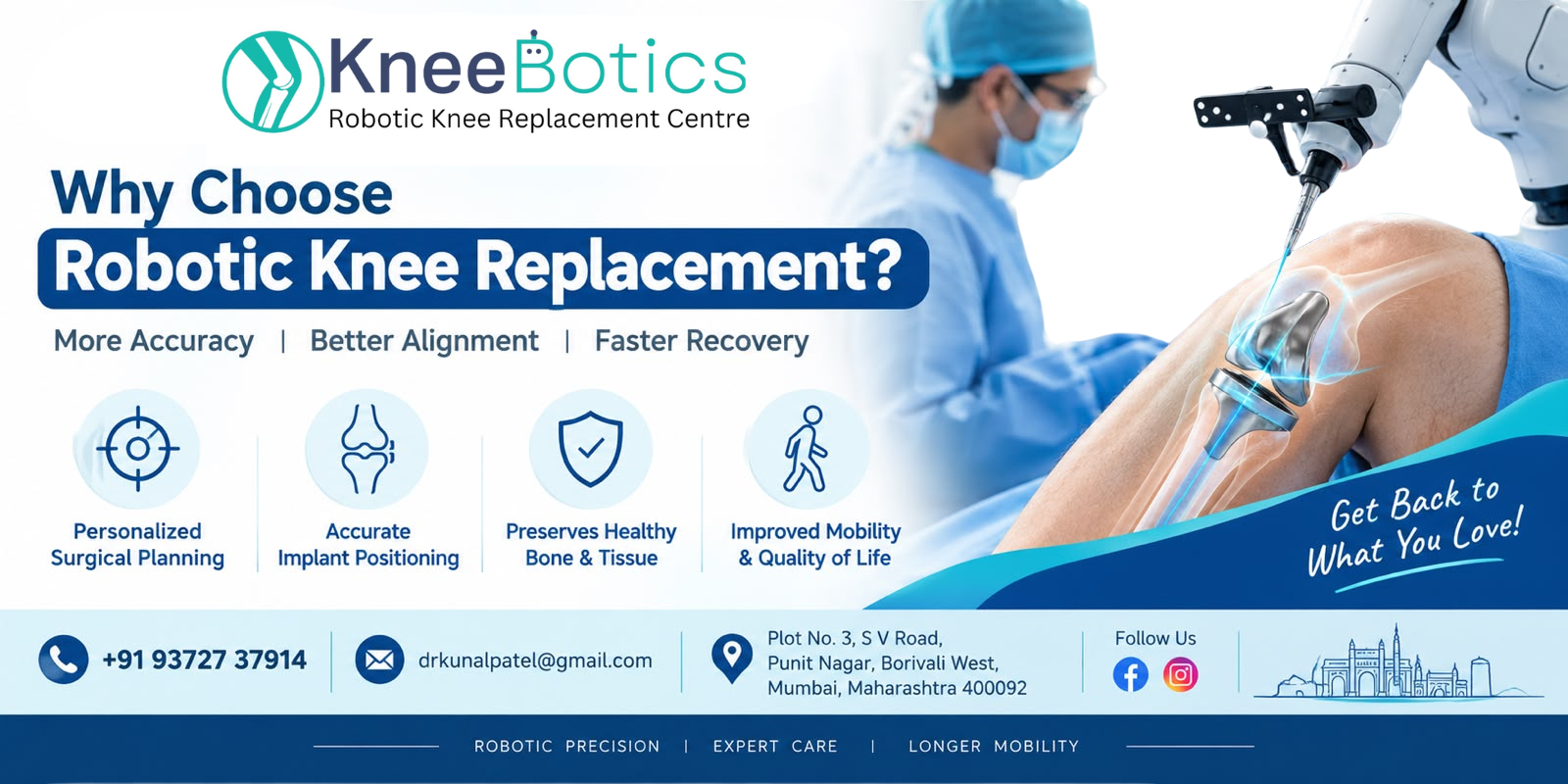
Persistent knee pain can dramatically change the way you live your life. Eventually activities such as walking, climbing stairs, getting up from a chair and standing for long periods can become difficult. While knee arthritis and severe joint damage may be treated with conservative methods such as medications, Physio therapy and lifestyle modifications, surgery may become inevitable.
The field of orthopaedics has improved and so has the technology. Robotic surgery has improved knee care. Robotic knee replacement in Mumbai has orthopaedic surgeons who, along with their years of experience, plan surgeries using Robotic and computer technologies.
This helps them improve accuracy during selected knee replacements.
You may have many questions about robotic assistance. Is it better than conventional knee replacement? Is it right for you?
Before making a final decision, there are a few things you should know.
Things To Know Before Opting For Robotic Knee Replacement
Robotic assistance does not mean a robot performs surgery. The surgeon is always in control.
Robotic technology is a powerful tool to help perform surgeries. Based on the system in use, it may provide the surgeon with real time information during the surgery to help with aspects such as bone preparation and implant positioning. The overall goal is to keep the surgery as controlled and as personalized as possible.
Before making your final decision, you should do your own research and find out what else is out there.
The amount of arthritis, the shape of your bones, the condition of your ligaments, the alignment of your limbs and the overall health of your joints can vary a lot from person to person.
As knee replacement surgery is increasingly being guided by robotic technology, surgeons can expect to have additional information when planning and performing surgery. Some benefits may include:
1. More Individualized Surgical Planning
Knee replacement surgery, typically, relies on averages and standards, and may not always account for the individual variances that are present in each patient’s anatomy. Robotic technology aids in the creation of a more individualized treatment plan.
This may allow surgeons to better assess the positioning and alignment of components during surgery.
2. More Accurate Bone Preparation
In a similar manner, the technology may assist in the achievement of the planned cuts to the bone to better reflect the individual’s anatomy, especially if precise positioning is essential for a well-balanced knee.
3. More Accurate Implant Positioning
The function of a knee replacement is dependant on the alignment and position of the implant. With this technology, the surgeon has the option of receiving more information to assist in reaching the desired position of the implant.
4. Preservation of Healthy Bone and Tissue
In selected cases, the technology can aid in achieving a more controlled and individualized bone preparation. This is especially applicable in a partial knee replacement where healthy bone may be preserved.
- Support for More Individualized Approach
A key difference with robotic-assisted knee surgery is that every surgical plan is customized based on the anatomy and joint condition of the patient. Because of this, robotic systems have transformed the way various joint replacements are performed.
Total versus Partial Knee Replacement
The other major factor to consider is whether a patient requires a total or partial knee replacement.
Total Knee Replacement
Total knee replacement is indicated if arthritis or other joint damage is present in more than one area of the knee joint.
During surgery, damaged areas of the knee joint are replaced with an artificial joint. The knee joint is then lined with a plastic spacer. Using a robotic system can aid the surgeon in planning the surgery, prepping the bone and positioning the implants.
Partial Knee Replacement
Partial knee replacement may be considered when arthritis is present in only a single area of the knee joint and the other areas of the joint can be retained.
The goal of the surgery is to replace only the damaged portion of the knee joint. The healthy bone and joint structures can be preserved. This may result in a smaller and less invasive surgery with potentially better and quicker rehabilitation. However, this may not always be the case and there are several factors that must be considered prior to surgery.
Who May Be a Candidate for Robotic Knee Replacement?
Robotic assistance may not always be the best choice for every patient.
Your surgeon may consider it if you have:
- Advanced knee osteoarthritis
- Persistent knee pain that limits your daily activities
- Knee stiffness and/or limited range of motion
- Knee deformity and/or malalignment
- Joint damage that has not improved with non-surgical treatment
- A medical condition for which knee replacement is recommended
For Robotic partial knee replacement in Mumbai, specific criteria are considered. Usually, arthritis needs to be confined to a specific knee compartment and the other structures and ligaments of the knee joint need to be normal and healthy enough to preserve.
A thorough physical examination and appropriate diagnostic tests are done to determine the type of surgery to be performed.
Is Robotic Knee Replacement Better Than Conventional Surgery?
This is one of the most frequent questions that patients have.
Better results do not always depend on the use of advanced technology in surgery. Success of knee replacement mainly depends on:
- The surgeon’s correct assessment of the problem
- The surgeon’s experience and skills
- Judgment in deciding about the right patient for the surgery
- Selection of appropriate implant
- Correct surgical technique
- General health of the patient
- Intensity of physiotherapy and rehabilitation
- Adherence to post-operative instructions
For some patients, a traditional (conventional) knee replacement may be more appropriate. A good, experienced surgeon will make the decision based on the patient condition and not on the technology because of its recent advancement.
What Can Patients Expect During Their Procedure?
Although the exact process varies with different robotic platforms and types of replacement, the overall process generally consists of the following steps.
Step 1: Detailed Evaluation
During this step, the surgeon reviews the patients symptoms and history as well as performs a physical examination and reviews diagnostic images.
Step 2: Surgical Planning
Using the available anatomy, a surgical plan is created to address the issues identified during the detailed evaluation.
Step 3: Robotic-Assisted Procedure
Using the surgical plan and available anatomy, the surgeon controls the robot to determine the best position and alignment to place the knee replacement components.
Step 4: Implant Positioning
The component of the joint to be replaced is prepared, and the knee replacement implant is placed according to the surgical plan.
Step 5: Recovery and Rehabilitation
Recovery and rehabilitation after surgery is focused on regaining range of motion and the strength of the leg, as well as other activities to manage the edema and swelling in the leg, control pain, and learn safe walking and other activities of daily living.
What Can Patients Expect After Surgery?
Recovery after knee replacement is very individualized.
How long a person takes to recover after knee replacement is impacted by how weak their leg was before surgery, how unhealthy they were, the extent of arthritis in their knee, and the type of knee replacement they had.
Rehab focuses on the same goals as recovery.
What Factors Should Patients Consider When Choosing a Knee Replacement Surgeon?
Knee replacement involves a surgical team and the hospital, but having the best technology and a surgeon who understands how to use it correctly is very important. The most important factor in a successful knee replacement is the surgeon. If the technology is not available, finding a surgeon who can use a similar technology is very important.
When searching for a suitable option for robotic knee replacement in Mumbai, looking for a surgeon who has experience with robotic systems, and understand the pros and cons of both traditional and robotic surgery is extremely important.
Some questions that you should consider asking are:
- Is robotic surgery the best option for my knee?
- Do I require a partial or a total knee replacement?
- What type of arthritis do I have?
- What are the anticipated benefits and drawbacks of this surgery?
- What implant will be used?
- How long will rehabilitation be?
- What are the risks of this surgery?
- What type of follow up, and rehabilitation will I require?
- You should consult with the surgeon to gauge if you are a good candidate for this type of surgery.
Why Consider Robotic Knee Replacement in Mumbai?
Mumbai is a major hub for advanced orthopedic treatments. Some hospitals in the area have recently invested in more modern robotic total and partial knee replacement systems.
Patients should also be aware that, the most important factor is having the right combination of experienced surgical care, proper diagnosis and treatment, along with appropriate rehabilitation.
Conclusion
Taking all factors into consideration, knee replacement surgery using robotic systems is one of the big advances in joint replacement surgery. Most importantly, it gives surgeons the ability to take a more individualized approach to surgery.
Knee replacement can be performed using traditional methods or using robotic systems to perform the surgery. Robotic systems allow for surgical planning and bone and implant positioning. The surgeon is still in charge and controls the procedure.
Robotic assisted systems do not perform the surgery on their own.
Not everyone is a candidate for robotic-assisted surgery. Only patients with advanced arthritis or significant knee damage that requires knee replacement may be considered for the robotic-assisted procedure. Individual anatomy, medical condition, imaging, and the surgeon’s judgment contribute to suitability.
A partial knee replacement may be an option for patients with arthritis confined to one compartment of the knee.
FAQ
- Is robotic partial knee replacement an option for everyone?
No. Only select patients are candidates for this type of surgery. Factors such as the conditions of the other knee compartments and ligaments, leg alignment, and the range of motion all need to be taken into consideration.
- Does the use of robotics for knee replacement mean a faster recovery?
Recovery time is unpredictable. While surgical aids and advancements may offer benefits, the length of time a patient is required to take off work and be away from their normal daily activities is beyond the surgeon’s and the hospital’s control.
- Is a robotic knee replacement safer than a traditional knee replacement?
Robotic technology does not eliminate the potential risks of a surgical procedure. The type of surgery (robotic or traditional) a patient undergoes should be based on the individual’s needs and the surgeon’s expertise.
- How long will a knee replacement last?
How long your implants last varies. How active you are, what type of implants you get, the technique your surgeon uses, and your general health can all effect how well your knee functions in the long-term.
9. When should I see a knee replacement specialist?
Book a consultation with a knee replacement surgeon if you have persistent pain and/or stiffness in your knee that limits your walking or climbing stairs. You should also see a specialist if you have pain or stiffness that limits your ability to sleep or causes problems with your everyday activities. Note: Pain medication and other non-operative treatments are not solving your problems.
Book a Consultation
If you have pain and stiffness that limits your ability to walk, climb stairs, sleep or perform everyday activities you should see a specialist. A specialist can help you with your pain, stiffness and overall reduce your joint function.
NAP – Kneebotics
Business Name: Kneebotics – Robotic Joint Replacement Center
Address: Plot No. 3, S V Road, Punit Nagar, Borivali West, Mumbai, Maharashtra 400092
Phone: +91 93727 37914
Email: drkunalpatel@gmail.com
The address and appointment details are listed on the official Kneebotics contact page.
Follow Kneebotics on Social Media
- Facebook: https://www.facebook.com/KneeBotics
- Instagram: https://www.instagram.com/kneebotics/
